
Business Process Optimization: Meaning, Examples and Techniques for UK Businesses
Every business runs on processes, whether anyone has written them down or not. Business process optimization is what happens when a company stops letting those processes drift and starts deliberately improving them.
Business process optimization is the practice of reviewing an existing workflow, identifying inefficiencies such as bottlenecks or unnecessary steps, and redesigning it to reduce cost, save time and improve quality, without disrupting the outcome the process was built to deliver. It sits at the practical end of business process management, turning a broad strategy into specific, measurable changes on the ground.
For UK small and medium sized businesses, this matters more than the enterprise case studies you usually find online suggest. You do not need a six figure software budget to benefit from it. You need a clear method and the discipline to apply it.
What Is Business Process Optimization?
Business process optimization means taking a process that already exists, such as how invoices get approved or how new customers are onboarded, and systematically improving it. It is not the same as inventing a process from scratch, and it is not the same as automating everything in sight. It is a targeted, evidence based improvement to something your business already does.
Academic research treats this as a distinct discipline. Danish researchers Jan Stentoft and Anders Haug, whose textbook Business Process Optimisation is widely used on university operations management courses, frame it as a structured combination of process analysis, performance measurement and change management, rather than a single technique or piece of software.
What Does BPO Stand For, and Why Is It Confused With Outsourcing?
BPO most commonly stands for business process optimization in an operations context, but the same acronym is also used for business process outsourcing, which is an entirely different concept involving handing a function to a third party provider. If you search “BPO” and land on results about call centres or outsourced payroll, you have found the outsourcing meaning by mistake. This article deals exclusively with optimization.
Business Process Optimization vs BPM vs BPI vs BPR
These four terms get used almost interchangeably online, which causes genuine confusion. Here is how they actually differ.
| Term | Focus | Scope | Typical Trigger |
|---|---|---|---|
| Business Process Optimization (BPO) | Refining an existing process for efficiency | One process or a related set of processes | A process is slow, costly or error prone |
| Business Process Management (BPM) | Ongoing governance of all processes | Organisation wide | A permanent management discipline, not a project |
| Business Process Improvement (BPI) | Small, incremental fixes | A single task or step | A minor recurring problem |
| Business Process Reengineering (BPR) | Complete redesign from the ground up | A whole process or function | The existing process is fundamentally broken |
In practice, BPM is the umbrella discipline, BPO is where most improvement projects actually sit, BPI covers smaller tweaks within that, and BPR is reserved for situations where tinkering will not fix the problem.
Why Business Process Optimization Matters for UK Businesses
Inefficient processes cost money quietly. A purchase order that takes three days to approve because it passes through four inboxes is not dramatic, but it slows cash flow, frustrates suppliers and ties up staff time that could go toward growth. These costs rarely appear as a single line item, which is exactly why they get overlooked.
The benefits of getting this right include:
- Lower operational costs through reduced rework and wasted effort
- Faster turnaround times for customers and suppliers
- Fewer errors, particularly in finance and compliance heavy processes
- Better use of staff time, freeing people for higher value work
- Improved consistency, which supports quality and customer trust
Efficient operations also feed directly into financial performance. As explored in our guide to what turnover means in business, how efficiently a business converts activity into revenue has a direct bearing on margin, and process optimization is one of the most reliable levers for improving it.
Business Process Optimization Techniques
Several established methodologies underpin most successful optimization projects. You do not need to adopt all of them, but understanding each helps you choose the right tool for the job.
Lean focuses on removing anything that does not add value for the customer, originally developed within Toyota’s manufacturing operations.
Six Sigma is a data driven approach aimed at reducing defects and variability, often applied through the DMAIC cycle: Define, Measure, Analyse, Improve, Control.
Lean Six Sigma combines both, using Lean’s waste reduction with Six Sigma’s statistical rigour.
Kaizen is a philosophy of small, continuous improvements made collaboratively by the people who actually do the work, rather than imposed top down.
Business Process Reengineering is the most radical option, involving a full redesign rather than incremental change, and is best reserved for processes that are broken beyond simple fixing.
How to Optimize a Business Process: A Step-by-Step Framework
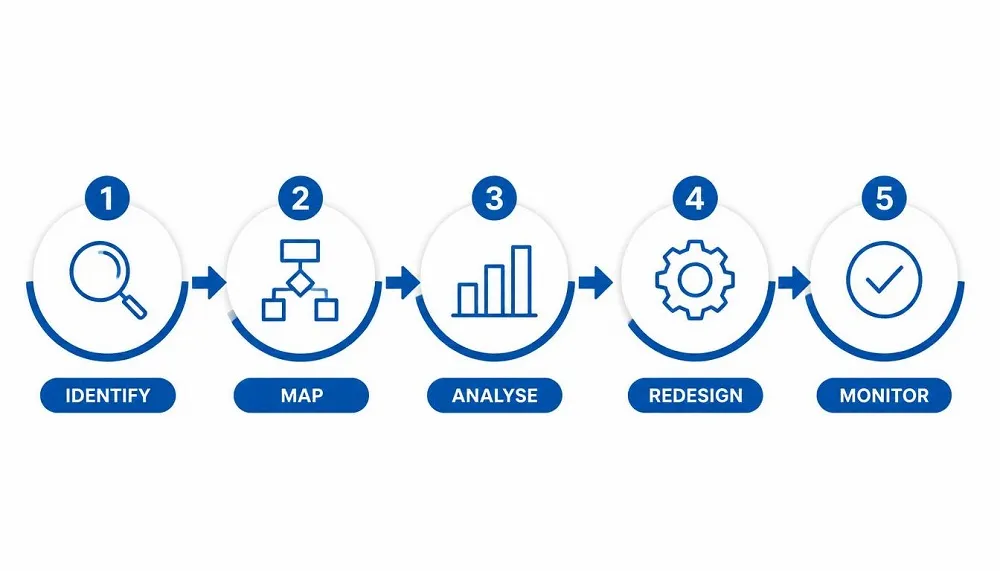
Step 1: Identify the Process
Choose a process that causes regular friction, whether that is complaints, delays, or errors. Prioritise based on impact and how frequently the process runs.
Step 2: Map the Current Process
Document every step exactly as it happens today, not as it should happen. Include who is involved, what tools they use, and where handoffs occur. This is often where hidden inefficiencies first become visible.
Step 3: Analyse for Bottlenecks and Waste
Look for repeated approvals, duplicated data entry, unnecessary waiting time, and steps that exist purely out of habit. Root cause analysis helps distinguish symptoms from the underlying issue.
Step 4: Redesign and Implement
Remove, combine or automate steps where sensible. Set clear key performance indicators before you change anything, so you can measure whether the redesign actually worked.
Step 5: Monitor and Repeat
Track the agreed metrics for a defined period, gather feedback from the people using the process, and adjust further if needed. Optimization is not a one off project, it is an ongoing habit.
Business Process Optimization Examples
Invoice approvals. A finance team replaces email based sign off with a simple digital approval trail, cutting average approval time from five days to one.
Employee onboarding. HR and IT coordinate through a shared checklist rather than separate email chains, so new starters have equipment and system access ready on day one.
Customer support routing. Support tickets are automatically categorised by urgency and topic rather than manually triaged, reducing response times during busy periods.
Small business order processing. A growing retailer moves from manually re-keying online orders into a separate stock system to a connected process, removing a common source of fulfilment errors.
These are illustrative examples of the kind of improvement most businesses can pursue without enterprise scale investment, procurement and operations processes benefit from the same disciplined approach described in our piece on lab procurement marketplaces, where sourcing efficiency directly affects the wider process.
Business Process Optimization Tools: A Brief Overview
Software is not a prerequisite for getting started. Many early gains come from simply mapping a process on paper and removing obvious waste. As processes mature, tools such as workflow automation platforms, process mapping software and process mining tools can help, particularly for tracking metrics automatically. We will cover specific tool categories and comparisons in a dedicated guide.
The Role of AI in Business Process Optimization
Artificial intelligence is increasingly used to support optimization rather than replace the underlying method. Machine learning can highlight patterns in process data that are hard to spot manually, while generative AI tools can assist with drafting documentation, classifying incoming requests, or summarising customer feedback linked to a process. These tools work best when applied to a process that has already been properly mapped and understood, rather than as a substitute for that groundwork.
Common Challenges in Business Process Optimization
Resistance to change. Staff who are comfortable with an existing way of working may resist redesign, particularly if they fear job losses. Involving them early reduces this friction.
Lack of clear metrics. Without a baseline measurement, it is impossible to prove whether a change actually helped.
Legacy systems. Older software can limit how far a process can realistically be redesigned without a wider technology change.
Where Process Optimization Fits in Your Wider Business Strategy
Process optimization rarely happens in isolation. It supports the broader operational foundation covered in our complete guide to building a successful business, where efficient operations sit alongside strategy, finance and growth planning as core pillars of a sustainable business.
Careers and Learning in Business Process Optimization
Roles such as process improvement specialist, operations manager and continuous improvement lead increasingly require formal grounding in these methods, often supported by Lean Six Sigma certification or academic study such as Stentoft and Haug’s operations management coursework. We will explore career paths and qualifications in more depth in a future guide.
Frequently Asked Questions
What is business process optimization?
Business process optimization is the practice of analysing an existing business process and redesigning it to reduce cost, save time and improve quality, without changing its core purpose.
What is the difference between business process optimization and business process improvement?
Optimization typically covers a full process end to end, while improvement often refers to smaller, incremental changes within that process.
What is the difference between BPO, BPM, BPI and BPR?
BPM is the ongoing management of all processes; BPO and BPI both involve improving existing processes at different scales, and BPR involves a complete redesign from scratch.
What are the main business process optimization techniques?
The most widely used techniques are Lean, Six Sigma, Lean Six Sigma, Kaizen, and business process reengineering.
How do you optimize a business process step by step?
Identify the process, map it as it currently runs, analyse it for bottlenecks, redesign and implement improvements, then monitor results and repeat.
Is business process optimization a good career?
It is a growing field, particularly in operations, finance and supply chain roles, with recognised certifications and academic pathways supporting career progression.
How does AI contribute to business process optimization?
AI can help identify patterns in process data, automate repetitive steps and support decision making, but works best once a process has already been properly mapped.
Key Takeaways
Business process optimization is a structured, evidence-based way to make an existing process more efficient. It differs from BPM, BPI and BPR in scope and intent, draws on established techniques such as Lean and Six Sigma, and does not require enterprise software to get started. For UK businesses of any size, a disciplined approach to mapping, analysing and monitoring processes is one of the most reliable ways to reduce cost and improve customer experience.
About the Author
This article was researched and written by the Business To World editorial team, drawing on established operations management literature including Jan Stentoft and Anders Haug’s Business Process Optimisation, alongside current industry practice, to provide UK business owners with a clear, practical introduction to the topic.