
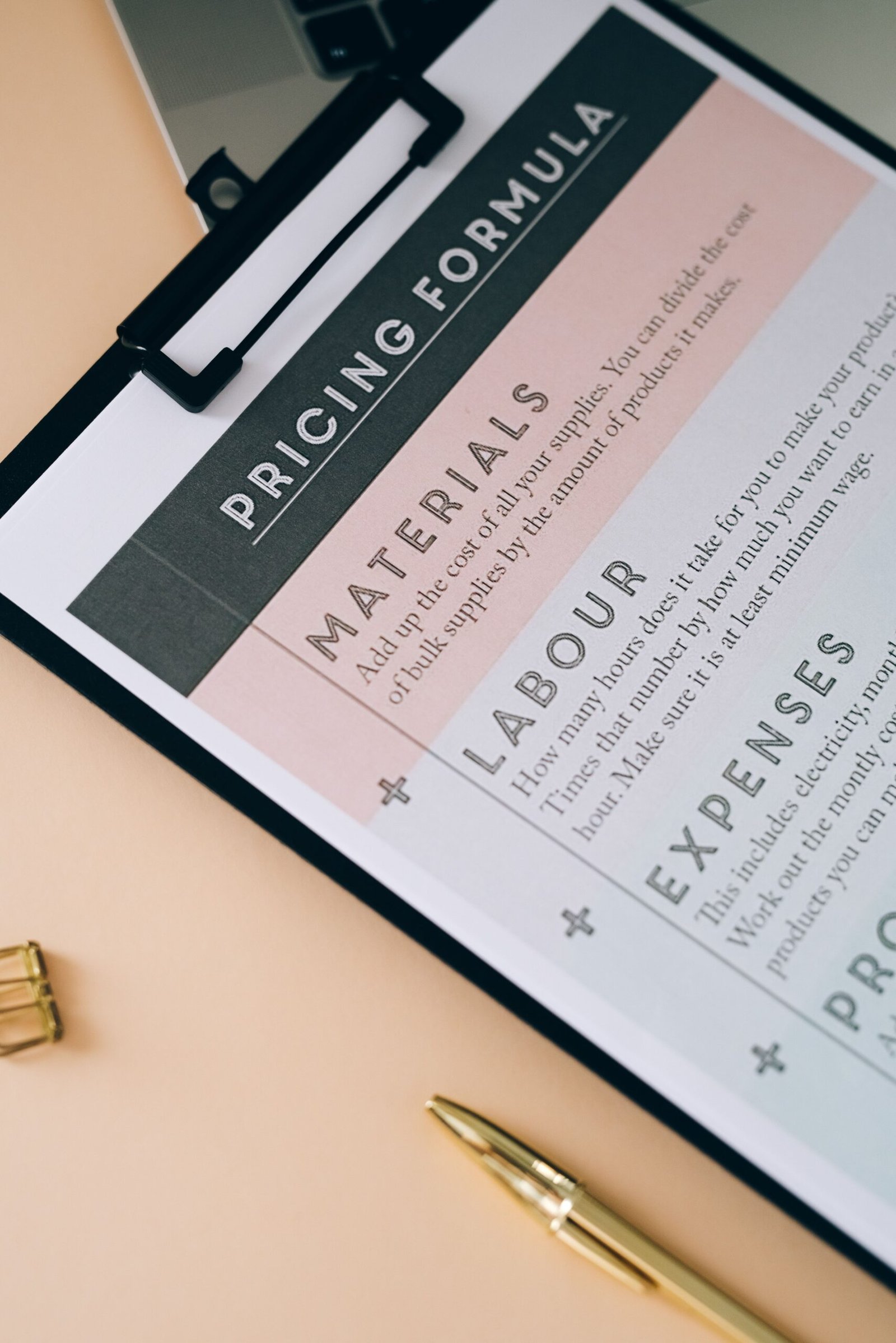
Choosing between cost-plus and value-based pricing is one of the first real strategic decisions a small business makes, yet the two methods are often confused or blended without a clear reason why. Understanding the genuine difference, and when each one actually serves a business better, prevents both chronic underpricing and the discomfort of guessing at a number with no logic behind it.
This is a spoke in our pricing strategy cluster. For the full pricing method, including a third approach and a practical decision framework, see our pillar guide on how to price your services as a UK small business.
What Is Cost-Plus Pricing?
Formula: Price = Total Cost per Unit + (Total Cost per Unit × Desired Markup %)
Cost-plus pricing starts with the actual cost of delivering a product or service, then adds a fixed percentage on top as profit margin. It is the most straightforward pricing method to calculate and the easiest to defend, since the logic behind the number is transparent and consistent across every job.
A Worked Example
| Item | Value |
|---|---|
| Cost per unit | £40 |
| Desired markup | 50% |
| Final price | £60 (£40 + £20) |
What Is Value-Based Pricing?
Formula: Price is set according to the measurable value or outcome delivered to the client, not the cost of delivering it
Value-based pricing detaches price from cost almost entirely and instead asks a different question: what is this outcome genuinely worth to the client? A piece of work that takes two hours to deliver but saves a client £20,000 a year is priced according to that £20,000 value, not according to the two hours spent producing it.
A Worked Example
A marketing consultant redesigns a client’s checkout flow, reducing cart abandonment enough to add an estimated £15,000 in annual revenue. Rather than charging an hourly rate for the days spent on the project, the consultant prices the engagement at £3,000, representing a clear and justifiable fraction of the value created.
Side-by-Side Comparison
| Factor | Cost-Plus Pricing | Value-Based Pricing |
|---|---|---|
| Basis for price | Cost of delivery plus margin | Value of outcome to the client |
| Ease of calculation | Simple and consistent | Requires research into client’s situation |
| Typical margin | Moderate, capped by cost structure | Often higher, uncapped by delivery time |
| Best suited to | Products, standardised services, high-volume work | Consulting, strategy, specialised expertise |
| Main risk | Undervalues high-impact work | Requires strong evidence of value to justify price |
When Cost-Plus Pricing Makes More Sense
- Products with standardised, repeatable production costs
- Services where output is fairly uniform across clients, such as bookkeeping or basic maintenance
- Early-stage businesses that have not yet built a track record of measurable client outcomes
- Industries where clients expect and compare cost-based quotes directly
When Value-Based Pricing Makes More Sense
- Consulting, strategy or specialist advisory work where outcomes vary significantly by client
- Services where the business has evidence, case studies or measurable results from past clients
- Situations where the client’s alternative cost of not solving the problem is high
- Businesses with an established reputation that supports a higher perceived value
Can the Two Methods Be Combined?
Many small businesses use cost-plus pricing as a floor, the absolute minimum acceptable price, while using value-based reasoning to justify pricing above that floor whenever a strong enough case exists. This hybrid approach protects margin on every job while still capturing additional value where it is genuinely present, and is covered in more detail as part of the three-layer pricing check in our main pricing guide.
Frequently Asked Questions
Which pricing method is more profitable?
Value-based pricing typically produces higher margins where it can be applied credibly, since it is not capped by the cost or time involved in delivery. Cost-plus pricing produces more consistent, if generally lower, margins across a wider range of work.
Is value-based pricing only for consultants?
No, though it is most commonly used in consulting and specialist services. Any business able to clearly demonstrate a measurable outcome for the client, such as increased revenue, saved time or reduced cost, can apply value-based reasoning to its pricing.
Why do new businesses default to cost-plus pricing?
New businesses often lack the track record or case studies needed to make a credible value-based case, making cost-plus pricing a more defensible starting point until enough evidence of client outcomes has been built up.
Does cost-plus pricing guarantee a business will be profitable?
Not automatically. Cost-plus pricing only guarantees profitability if the underlying cost calculation is accurate and complete, including often-overlooked costs like software subscriptions, admin time and irregular expenses.
About the author: The Business To World editorial team covers practical business, banking, investment and property guidance for UK small business owners and entrepreneurs.